Sunday, September 2, 2012

CHALLENGES FACING CARIBBEAN HINDUS IN THE US


Deepavali Puja at the Sanaatan Dharma Mandir of NY

In most scenarios, wherever a Hindu or a Hindu family relocate, they try their utmost best to maintain the cardinal principles involved in living a good Hindu life, regardless of the challenges facing them in their new environment. This was true of our East Indian Indentured ancestors who left the shores of India over 174 years ago to toil in sugar plantations of many British colonies around the globe. Their lives were reduced to arguably semi-slavery conditions, but they never gave up their strong believe in their unique Dharma. They learned to adapt to their new harsh realities but their unflinching faith in their beliefs kept them going in the good and the bad times. That is an important character trait that was passed on from one generation to the next. And, when subsequent generations seek brighter futures for themselves and families in more economically advanced countries, such as, the USA, Canada and England, they carried their religious and cultural beliefs wiith them.


The famous Ganesha Temple in Flushing, Queens
Hindus from the West Indies and other countries migrated to the US for basically the same goal: a higher education and a better life for themselves and their families. Amidst the many challenges they confronted in their new strange land, many of those early migrants persevered, worked hard, improved their lots and sponsored their families over. Today, the Hindu population in the US has increased by a sizeable amount, whether they migrated from the West Indies, India, Mauritius, Fiji or South Africa. According to the United States Department of State’s International Religious Freedom Report 2004, American Hindus is estimated at 0.5 % of the total population or over 1.4 million. That was seven years. Today, that number is probably doubled. The number of mandirs they are putting up in their communities are also on the rise.


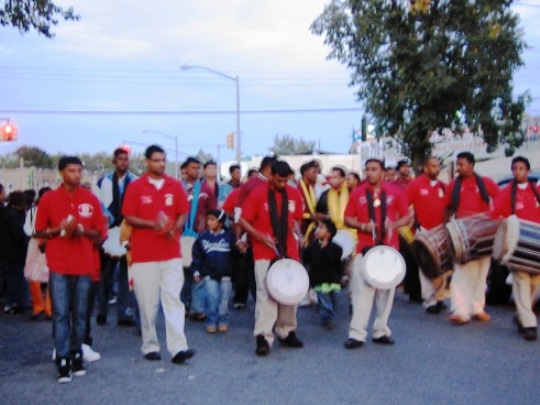
Tassa Group 'beating' their drums at a Diwali Parade on Liberty Avenue
But, the challenges facing American Hindus remain and are still daunting. These can be categorized in different groups, such as, the many challenges they faced in living and raising their children in a predominantly Christian society; due to the heavy Western influences, many parents exercise poor judgment in their parenting styles, many tolerate their children to practice the American lifestyle and forsake their own, so many petty in-fightings among themselves and the lack of understanding of Sanatan Dharma by other faiths.


The popular Sybils is one of the first restaurants to open up on Liberty Ave by immigrants from Guyana
Before migrating to the US, many of them lived in a predominantly Hindu society. In the US, they find themselves living and raising their children in a predominantly Christian society, where the way of life is vastly different from theirs. They now have to acclimatize themselves to their new surroundings and devise ways to maintain their unique Indian heritage and culture. In lieu of that, one of the biggest challenges Hindu parents face is transmitting the rich traditional and cultural values to their children. Many of them are finding it very hard to raise their children in the same disciplined manner they grew up in. Hence, there is a visible pattern of a continuous degeneration of the good "old-fashioned" Hindu values among young American Hindus. Just take a walk down the bustling Liberty Avenue in Richmond Hill at the end of any given school day. Groups of school children of East Indain descent can be found aimlessly walking home and they don't care if you hear their fowl language. Their freaky way of dressing would raise eyebrows, to put it mildly; their crude mannerism and poor conduct in public not only left much to be desired, but it speaks volume of their parents. Some would argue that parents do their best and in many instances, the children do their own thing with their peers at school and int eh streets. Well then, let's reassess that old saying: "Charity begins at home."  

Admittedly, the US is a very complex society, where "a melting pot of cultures" strives. But, according to Mr. Anantanand Rambachan, Chairman of the Department of Religion at St. Olaf College in Minnesota, “Hinduism is the least understood religion among American religious traditions.” An immigrant from Trinidad, Mr. Rambachan was a speaker at the conference on Hinduism in America, in Minnesota a few years back.

The famous Liberty Avenue in Richmond Hill, Queens

There are many reasons for the demoralization of the American Hindu society. Due to societal demands and trying economic times, in many Hindu homes, both mother and father are forced to work to make ends meet. A lot of their time and energy are directed towards juggling one task after another and not much quality time is spent with their children. There is not much official statistical data available to support this issue, but the facts speak for themselves. Just observe a Hindu family for a day to find out. In many Hindu homes, children are allowed to do things their way because of a lack of proper adult/parenting supervision. They watch a lot of TV with a strong influence of the Pop culture lifestyle; they play sometimes very violent video games; they listen to the latest Hip-Hop, string and heavy metal music and eat plenty of fast food, which are all easily accessible to them. This is the Westernized world they are growing up in and are sadly, embracing and can relate to.

Richmond Hill, Queens, New York, has a large population of Hindus who migrated from the West Indies and other parts of the world. Indeed, they have made great economic strides over the years. Many open and manage their own successful businesses in the community, which are lined on Liberty Avenue. Unfortunately, the famous avenue is home also to many night clubs, bars and lounges. On any given Saturday night, most of the popular hangout spots for the youngsters in the Richmond Hill area, is packed to capacity with young men and women: drinking, smoking, dancing and partying. Many of them are Hindus. Guess what? On the Sunday mornings, the turnouts at the mandirs are just the handful of the faithfuls – call them the frequent mandir-goers. The others are sleeping their hang-overs from the night before. This is just one scenario.

Acharya Krishna Moorty, the spiritual head at the Chinmaya Mission in New York, believes that one of the issues that Hindus face in the US is not knowing, “how to balance the standard of living with the standard of life. Acharyaji explains that the “standard of living is a measure of our lifestyle” which include, “education and skills, comforts, conveniences, financial security, objective pleasures and sensual indulgences, aimed towards happiness in life.”

On the other hand, he adds that the standard of life is a “measure of our faith, belief, values, attitudes, character, inner peace of mind, happiness, satisfaction and completeness, aimed towards happiness of life.” He points out that both are necessary, however, Hindus have to learn to prioritize their lives.

Young American Hindus also have issues to contend with. One of their main arguments is that Sanatan Dharma is confusing and too complicated because of the many Gods and Goddesses to be worshipped. Further, they pointed out that the rituals are many, lengthy and time-consuming. Then, there is the language barrier. Many of them, particularly those from the Diaspora, understand and speak only English. Therefore, they cannot grasp the meanings of the prayers, mantras or bhajans since these are written in either Sanskrit or Hindi. For these reasons, some young American Hindus feel reluctant to to practice their religion, others feel ill-informed about their religion and there are many who do not even identify themselves as Hindus.

Many of them have adapted the American lifestyle to blend in the American society because it is easier to do. Another major setback for American Hindus is that many of the Hindu festivals, such as Deepavali and Phagwah, are not recognized in their schools and well, mainstream America, for that matter. Celebrations for these festivals have to be performed in the evenings or on weekends, when it is more convenient for the families and mandirs to conduct such pujas. These are critical issues that have caused a major breakdown in the rich Hindu family tradition and also, one of the many reasons for youngsters to go astray. As a result, many young American Hindus are loosing their identity in the process.

Acharyaji asks the hard questions: “Identity, who are we?” Then, he throws in the million dollar question, “How can we really blend with the American society and still retain our identity?”

That has been a major roadblock for many American Hindu families. However, for every problem there is a solution. Acharyaji believes that “the solution depends on the assimilation the good values of both cultures and asserting our own heritage against aggressive cultures,” adding that “at the same time tolerating certain inadequacies and human errors in interacting with other faiths and culture.”

In most isntances, there is a solution to every problem, American Hindus have to seek them out. More than ever before, there is a need to have a unilateral system in place whereby all mandirs in the US are affiliated with one umbrella organization that would monitor the works of all mandirs across the country. This is a huge challenge by itself, but the dividends to be gained would be worthwhile. This parent body would have a long list of responsibilities to oversee, one main one being, to act as a mediator and a peace negotiator for the countless mandirs that are currently fighting their “Mahabharata wars” via a court system that does not understand their cultural values. The idea for an umbrella body would also bring a sense of uniformity among all the Hindu religious institutions and would admittedly, cause less conflict when calculating the correct dates for Hindu festivals for the calendar. Wouldn’t it be great if all mandirs in the US were to celebrate Deepavali or Shiva Ratri on the same day?

Next, the parent body needs to come up a set of basic rules for individuals interested in becoming pandits. This is a very contentious situation among the Hindus in the US and further afield and have to be addressed now or in the near future. Pandits must be properly educated, must be literate in speaking, writing and understanding Hindi and Sanskrit, must know how to perform major pujas and parbs, must be versed in Hindu scriptural texts, not only the Puranas, but also the Upanishads, which is the end part of the Vedas. The Upanishads contains the highest spiritual truths, which is criteria for liberation from mundane exitence. Pandtis must be groomed and nurtured from a very young age and must mostly certainly, conduct themselves in a morally upright manner. It is not a bad idea to give them a written test before they can practice ‘panditai’ work in the community. There are too many unqualified people calling themselves pandits who are misleading the Hindu population. This needs to be stopped.

Another pivotal issue that has to be addressed, now or later, is the one on the construction of Hindu schools in the community. It is imperative that the Hindu community pools its efforts, resources, money, time and energy together to work towards establishing Hindu schools and Hindu Universities in the US, in order to educate and nurture the growing young Hindu population. There is a demand for such institutions and the benefits therein are inumerable. Learning the Hindu concepts and ideas from a young age at a reputable Hindu school would encourage American Hindus to practice their religious beliefs with a sense of pride and joy. The only way they would be able to do that is if all or most of their misconceptions of Sanatan Dharma are removed and they understood this dynamic religion that is theirs. As the Mahatma once said, “A nation's culture resides in the hearts and in the souls of its people.” (Bina Mahabir)

Another view of Liberty Avenue


Friday, June 8, 2012

HATHA YOGA - AN INTERNATIONAL PHENOMENON!

Yoga has become an international phenomenon - overnight it seems. Whichever corner of the globe you may be residing at, you must have heard of yoga. Often time, the word Yoga is being used too loosely and at other times, some people don't even understand the deeper, true meaning of yoga. This article is written in "layman terms" with the intention of shedding some light to the lesser informed folks out there on the subject in the community.

So, what is yoga?

Yoga has many dimensions and basically, when many people are talking about it, they're referring to Hatha Yoga, which are the many, many body postures referred to as Asanas. Asanas in itself has been categorized into different groups with specific results for different peoples' needs.

Admittedly, yoga is not an easy subject to write on, with so much information already out there, but it needs to be written in simple language for all to grasp.

In an article posted on the website, www.abc-of-yoga.com, hatha yoga was by Yogi Swatmarama in ancient India.

(Will continue on this later)    

Monday, May 14, 2012

CELEBRATING OUR INDENTURED ANCESTORS' RICH HISTORY


                                          Dr. Basdeo Mangru delivering his keynote address

The Sanaatan Dharma Mandir of New York organized an event to celebrate the "Indian Arrival Day" of our Indian Indentured Ancestors to the West Indies to Guyana. This year marked the 174th years of our  ancestors' dynamic history and rich heritage to the West Indies. The event was held at the mandir, located at 104-22 114th Street, Richmond Hill in Queens, NY, on Sunday May 6th.

Such celebrations are held in the different countries in the Global Indian Diaspora, where over a century ago, the British plantation owners took the Indians from India as indentured laborers to "toil and sweat" in their sugar plantations. In British Guiana, slavery was abolished in 1834, after which the African slaves refused to work in the plantations. The plantation landlords found themselves in a quagmire; they scrambled to fill that gap with cheap laborers from Europe, but those attempts failed dismally. Finally, they turned to India to import cheap laborers. India was also under British rule, so their work was made easy, especially, after they painted a rosy picture of "plenty food, plenty clothing and plenty money" for the laborers.

A section of the gathering
The executive body and members of the Sanaatan Dharma Mandir of New York planned this event to coincide with the "Indian Arrival Day" celebrations in Guyana, which is observed on May 5th and is a national holiday in that country. Previously known as British Guiana, the first two ships that arrived at Highbury, East Berbice were the Whitby and the Hesperus on May 5th, 1838. Indenturedship was a five-year contract, whereby the Indentured laborers were bound to work on the sugar plantations for five years before they were free to return to India if they could provide their own passage.

The children of our ancestors reading
It was a short but packed program at the mandir. The keynote speaker was Dr. Basdeo Mangru who is one of Guyana's and the West Indies' most distinguished historians. Dr. Mangru specialized in the Indentured ancestors' history in Guyana, a subject that is very close to his heart. He is the author of several books written on the Indentured laborers' history. His lecture was extremely well presented. He talked about how the recruitment process for the laborers started in India, the many voyages they made across the "Kala Pani" (which means Black Water) and their harsh struggles against the indentured system on the sugar plantations across the colony. It was a concise but well-documented history lesson on our indentured ancestors' experiences that many in the audience was not aware of.

The program was sprinkled with children of the mandir reading empowering statements about the rich characteristics of their indentured ancestors and the sterling contributions they made to Guyana to help in that country's socio-economic and political developemnt and their struggles for a free Guyana. The event was ended with a powerful and informative slideshow that depicted their hard but humble lives on the sugar estates. Pictures were shown of the ancestors' cutting canes, loading the sugar punts, living in their grass houses and fetching loads on the donkey-carts, among others. Mention was also made of the Kolkata Memorial and museum that is being built in India and spearheaded by GOPIO International in honor of the Indentured ancestors.

Wednesday, November 9, 2011

THE GREATNESS OF GANGA MATA - OUR ANCESTORS HAD UNFLINCHING FAITH IN HER

Hindus globally will be observing the auspicious day of Kaartik Snaan or Tirath (Ganga Purnima), as we call this day in Guyana, on Thursday, November 10. It's a day when we visit Ganga Mata early in the morning at the seaside and offer our prayers and obeisance to Her. It's a holy ritual that our brave ancestors performed year after year at the sea shores. It's safe to say that our ancestors had unflinching faith in the great Ganga Mata - a tradition that they passed on to us.

Growing up, Tirath was one the festivals that my cousins and I looked forward to. You see, we get to go to the sea shores with the elders and bath in the salty sea waters. We observed the elders as they made their offerings to Ganga Mata. And as naugthy children, when the elders were out of waters, we made our way in and searched for the prasad (fruits) they had offered.

But later on, we realized the importance of taking baths in Ganga Mai and offering our prayers to Her. Ganga Mata is extremely revered by Hindus in the Caribbean. Until this day, Hindus go to Her by the hundreds and unload all their worries at Her lotus feet. They have the strong believe that She realeases them from their troubles in life.

The story of Ganga Mata is a beautiful one. According to Hindu scriptures, Ganga Maa came from the Kamandhal of Lord Brahma and was poured on Vaaman's Bhagwan's toe. So, Ganga Mata originates from Lord Vishnu's toe. King Bhagirat, who was the 4th generation of King
Sagar, did immense tapasya to bring down Ganga Mata from the heavens to earth to release his ancestors from their curse and ultimately grant them moksha.

If Ganga Mata had come with Her great force, She would have flooded this world and gone to Patal lok, which would have been useless for Bhagirat. He was adviced to pray to Lord Shiva to accept Ganga Mata in His jata and kept Her flowing from there. From Lord Shiva's locks, Ganga Mata's source on earth is at Gaumukh (Gaumukh means cow's mouth because the shape of the ice formation is like a cow's mouth), where the mighty river emerges from the depths of the Gangotri glacier, which is 4, 255 meters above sea level and approximately 24 km in length and 7-8 km in width in the Himalayas.

Ganga Mata has several streams and names, including: Ganga, Mandakini, Prabhawathi, Bhagirati, Janhvi, Sita, Nalini, Pavini and Soochakshu. Her greatness is mentioned in several Hindu scriptures including, Valmiki's Ramayan. And until today, Hindus simply adored this great Mother.

Tomorrow is also Satyanarayan Vrat Katha. It is said that the month of Kartik is extremely auspicious for the worship of Lord Vishnu and His incarnations. This Satyanarayan Vrat is very special. It is believed that Lord Vishnu took the form of Matsya on Kartik Purnima. In the month of Kartik, Hindus are adviced to wake up early and take showers before the sun has risen. This helps one to achieve the four goals of life: dharma (religous merits), artha (wealth), kama (marital life), moksha (liberation).

The early morning, just before the sun rises, is called Brahma-Mahurat. This means that most of the people are in deep sleep and nobody will disturb you, so it is the best time to worship God. The atmosphere is sacred, peaceful and conducive to praying because there are little vibrations emanating from the collective minds of people involved in all matters of the world since they are asleep. So the mind is very focused on prayers then.

So, tomorrow, Hindus are advised to wake up early in the morning and since many of us cannot go to Ganga Mai, we can take baths with some Ganga jal and offer prayers to Her during the bath. However, we have to be properly clothed, that means, we must wear our under clothings. Then, offer prayers to Lord Ganesh.

We are advised to keep a strict fast, a pure mind, meditate and worship the divine Mother. May Ganga Mata shower Her blessings upon all.

Below are online photos...

The snout of the Gangotri glacier at Gaumukh


The Gaumukh glacier


Ganga Maa at Gaumukh glacier


The Gaumukh origin

Monday, October 31, 2011

SUCCESSFUL MAAZA MISS INDIA NEW YORK & MISS TEEN INDIA NEW YORK 2011

IFC just presented its 29th Maaza Miss India New York and the 4th Miss Teen India New York pageants at the Community Center Auditorium in Flushing, Queens, on Sunday October 30. The event attracted some very beautiful, talented and intelligent young ladies from the South Asian community in the New York region.

This year's Miss Teen New York seemed to enlist some very young contestants, the youngest being 13-years-old of the eight contestants who took the catwalk. The contestants for the Maaza Miss India New York are somewhat older.

The young ladies displayed very gorgeous Indian outfits, including the elegant saris, lehangas and cholis; show-stopping gowns and then, showcased their special talents to impress the judges. Many of the contestants chose to perform dances for the talent pieces - to the beats of traditional, folklore and Bollywood songs. There is also a Q & A session where the contestants are requested to choose an envelop that contained a question for them.

The evening was sprinkled with spell-bounding performances from very young dancers of the famous Arya Dance Academy who just wowed the crowd with their impressive group dances.

The culmination of the contests was the crowning of the "queens" of both the Maaza Miss India New York and Miss Teen India New York for 2011. The winners of both pageants were very deserving of the crowns: Miss Chandan for the Maaza Miss India New York and Miss Sumeet for the Miss Teen New York.

There are many ways these young ladies benefit from such an event as this pageant; as they mentioned during their introductory speeches. They entered the contest to help them build their self-confidence, meet other young people, make new friends, represent their rich Indian culture and have a good time.

Mr. Dharmatma Saran and his team always do a great job of organizing a wonderful pageant for the young ladies, which provide a great platform for them to be young ambassadors of their Indian heritage.

Good luck to the winners!

Below are some cell phone photos of the event.

Young dancers of Arya Dance Academy ...


The winners of both pageants with other contestants...


Young performers of the Arya Dance Academy

Contestants of the Maaza Miss India NY ...

This young trio delighted the audience with their Lord Krishna performance..

The young ladies resplendent in their Indian outfits...

Winners being crowned by last year's winners ...