Sunday, September 29, 2013

GRAND ‘DHARMA & YOGA FEST’ IN HONOR OF SWAMI VIVEKANANDA’S 150TH BIRTH ANNIVERSARY

The positive energy of the people was tangible. One could feel the peace, warmth and friendly vibes emanating from all corners of the main hall – the Bhakti Yoga room. People turned out from all walks of life, far and near, to learn and to acquaint themselves with this towering, legendary personality. It was a grand affair organized to honor and celebrate the life of one of India’s most iconic Hindu spiritual monks of the highest order – Swami Vivekananda.  
Swami Vivekananda at the Parliament of World Regions in 1863
It was appropriately titled “Dharma & Yoga Fest,” with the theme focusing on the “spiritual celebration of Universal Oneness.” The event was held to commemorate Swami Vivekananda’s 150th birth anniversary on Saturday September 21, at the majestic Highlands Middle School in White Plains, New York.

“Dharma & Yoga Fest” was held under the aegis of the White Plains Cares Coalition, in conjunction with the Hindu Swayamsevak Sangh (HSS), a US-based non-profit organization which helps to organize social, cultural and educational activities for Hindus and non-Hindus throughout the United States of America.

HSS was instrumental in coordinating similar cultural and educational programs like this one throughout the United States. All of them were held to pay homage to this Indian spiritual giant whose contribution to mankind is immeasurable.

Dignitaries of stage at Bhakti Yoga track
 The day’s event was officially opened with the sacred lighting of the lamps by the invited dignitaries at 1 p.m. and was followed by a rich cultural program in the Bhakti Yoga track. Throughout the day, various local officials took to the stage to address the gathering, including Mayor Thomas M. Roach, who conducted the official inauguration.

There were four tracks running parallel in different rooms, covering the four major branches of Yoga – an ancient Indian school of thought that stated if followed in the truest form, the teachings help the individual become a Self-realized person while still alive, like Swami Vivekananda. The four types of Yoga are Bhakti Yoga (Devotion), Jnana Yoga (Spiritual Knowledge), Karma Yoga (Selfless Action) and Raja Yoga (or Hatha Yoga which is physical postures aim towards keeping the human body and mind healthy and balanced). All four branches were beautifully showcased at the program.
 
Kuchipudi dancers at their best on the talis

 At the Bhakti Yoga track, the program consisted of eloquent chanting of sloks from the Bhagavad Gita by two young kids, mesmerizing Indian Odissi and Kuchipudi dances, including dancing on talis by highly skilled dancers and kirtan singing by several groups. The introductory part of the cultural show was competently chaired by Rudra Upadhyaya, who is an official of the New York chapter of HSS.

At the Jnana Yoga track, a lively panel discussion was held on the Bhagavad Gita, a sacred Hindu scriptural text written in Sanskrit and whose dynamic teachings surpass boundaries of all kinds because its universal appeal to humanity as a whole. The Bhagavad Gita is being studied by students from all over the world, from all walks of life, from ancient time to present day modern time. The panelists included Dr. Graham Schweig, Dr. Yashwant Pathak, Dr. Rakesh Shreedhar and Reverend Mathew Wright.

Ready, steady ...  here I come!
It was Kids Kingdom at the Karma Yoga track and selfless service in action. There was the Fancy Costume competition where infants to eleven years-old participated for prizes. They were fancifully dolled up as prominent Indian historical and religious figures, such as Mahatma Gandhi, Meera Bhai and Shri Rama, among others. Here also were various game stalls for the children and prizes if they won at their specialties. There were also several vendor stalls marketing their brands and products to the passing crowd. Children were treated to some story-telling of the Native American Story, there was a Yoga session and a Puppet show.

At the Raja Yoga track, the Science of Breathing was explained by Dr. Sarita Patel, the Techniques of Stress-free living was presented by the Brahma Kumaris, Laughter Yoga (you read correct!) was demonstrated by Beth Kaplan Bangor to the uproar of the audience, Everyday Yoga was demonstrated by Dr. Vimala Bhatt and a Q & A session by one of Yoga’s living legend, Tao Porchon-Lynch.

Kiran from Sanaatan Dharma Mandir of NY as Swami Ji
The highlight of the day’s event was the much anticipated skit depicting several critically important aspects of Swami Vivekananda’s life. The skit was spearheaded by Dr. Sai Patel, who heads the women branch of the Hindu Swayamsevak Sangh in New York. Portions of the skit was enacted by children from different HSS groups from different areas, including, Connecticut, Westchester and Queens. Sanaatan Dharma Mandir of New York, a mandir based in Richmond Hill, Queens, was the only mandir that participated in the skit.

Kids performing one of the scenes of the skit
The children performed their roles as if they were professional actors. Emphasis was placed on all of them to know their many lines by memory and that they did. They depicted Swami Ji’s life in India, his meeting with Professor John Henry Wright of Harvard University and his historical speech at the first ever held Parliament of World Religions held in Chicago in 1893.

Swami Ji’s famous opening lines, “Sisters and Brothers of America” not only captivated the audience but he received a standing ovation from the entire congregation. The inherent message was that of universal brotherhood and tolerance – principles taught in the ancient Hindu philosophy “Vasudhaiva Kutumbakam,” which translated to mean “The whole world is one family.” The children did justice to their roles and held the audience spellbound to the end. Compliments must go to Sai Ji and her team of hard working individuals for putting this huge skit together.

Swami Ji was hailed as The New Spiritual Rock Star
Swami Vivekananda was born on January 12, 1863 as Narendranath Dutta in Calcutta to parents Vishwanath and Bhuvaneshwari Devi Dutta. As a child, Swami Ji was extremely close to his mother who was a very religious person. She taught him stories from the Ramayan, Gita and Mahabharat. These were scriptural texts he grew up to love and enjoy reading himself. Thus, began his undying quest to find God. Ever so often, when he had opportunities to meet saints and sages, he would ask them the million dollar question, “Sir, have you seen God?”

His desire to see God came to a halt when he met Swami Ramakrishna Ji, who eventually became his Guru. When he asked Swami Ramakrishna Ji, “Sir, have you seen God?” The Swami replied, “Yes, I’ve seen God just as I’m seeing you.” Finally, he found the spiritual master he was looking for and the rest, as they say, is history. Swami Ji gave up the mortal coil on July 4, 1902 but his principles of universal tolerance, goodwill, harmony and brotherhood for mankind live on in hearts of all of us.

Devotees of the Sri Chinmoy Center
 Devotees of the Sri Chinmoy Center of New York conducted an enchantingly soul-stirring and fitting tribute for Swami Ji. Their inspiring presentation of soothing kirtans and lovely short messages brought a sense of serenity, peace and tranquility in the Bhakti Yoga room, as the curtain was about to be drawn on a day jam-packed with programs.

"Dharma & Yoga Fest” was extremely well planned, thought out and skillfully executed by the HSS officials. Everyone involved in the planning of this event must be lauded for the hard work, effort, dedication, energy and selfless service they put in to create a program so richly deserving of Swami Ji’s exemplary life.
And as Swami Vivekananda once said, “Blessed are those whose bodies get destroyed in the service to others.”

Hats off to all of you for a job well done!
Dr Graham Schweig during his presentation at Jnana Yoga

Sunday, August 25, 2013

"MUSIC IS PART OF MY SOUL" ---

Kinnar Ji in "oneness" with the sitar
(Editor's note: This article was published in the West Indian newspaper in New York - dated 8/24/13. No parts of this article can be reproduced without permission from the writer).

Internationally-acclaimed Sitar Exponent and Trained Indian Classical Musician Pandit Kinnar Seen

Indian classical music pulls at his heart beats. In fact, the very essence of his being pulsates with the rhythm of this magical musical genre. He has been playing and teaching Indian classical music with such passion and soulfulness for so long - that he has become the music, which he stated, “connects me to my people, regardless of which part they’re from; it’s part of our Indian identity.”

Meet Pandit Kinnar Kumar Seen! He is an internationally-acclaimed exponent of sitar and a trained Indian classical singer/musician who lives to play and teach music to anyone who is willing to learn this ancient art form. Despite the international fame, heaps of accolades and numerous awards, he remains the epitome of humility, extremely modest, full of devotion for his music and is blessed with a prayerful heart and a great family.

During a recent interview, when asked how important Indian classical music is to him, this easy-going music Guru simply replied that, “music is part of my soul.” Music is the “food for the soul” that he cannot sleep or live without, “I can’t even sleep if I don’t play music.”

Then, he added softly but matter-of-factly, “If I cannot play music, then let my God take me away because life without music is no life.” Through the medium of performances and teaching, he is trying to keep Indian classical music alive and vowed to continue, “For as long as I live.”

Unwittingly, he touched a chord in the inner core of himself unfathomable to many of us. You see, music runs extremely deep in his genetic make-up and his spiritual consciousness; so much so that, it is appropriate to say that as fragrance is to roses, Indian classical music is to Kinnar Seen.

So, how is he able to achieve this seeming subtle “oneness” so effortlessly with the music he plays, especially with the sitar, which he shares a very strong bond with?

“It’s not me or what I’ve achieved, but I must have come with these qualities; this is because of my sanskars,” he stated modestly, emphasizing that, “It’s my Dharma.”

MUSICAL BACKGROUND

Was it celestially blissful growing up in a home where the soothing sound of the sitar and scintillating beats of the tabla filled the atmosphere?

“It was normal going up in a musical family,” Kinnar Ji stated honestly, being the down-to- earth person that he is, and continued, “my father is my Guru,” however, he succinctly pointed out that it was not always easy studying under his father.

He grew up in Jalandhar, in the state of Punjab, North India, where he was exposed to the traditional Punjab Gharana style of music from a very tender age.

His father, Acharya Ji Lachman Singh Seen, is a legendary musician in India and is also very well-known on the international musical circuit. Acharya Ji Seen started Sangeet Vilas, a musical school in his home town, teaching Indian classical music, specializing in the sitar and tabla.

The Seen family is not only extra-ordinarily gifted musicians but also Raput landowners. Kinnar Ji came from a long line of ancestors who were also rulers for their state. His late mother, Shrimati Shakuntala Rani Seen, was very influential in him studying music and becoming the full fledged, versatile professional musician he is today.

“She is the reason I’m in music,” he credited his mother for his blessings.

Thus, the young Kinnar began his musical journey, studying under the guidance of his father, along with so many other students who were always coming to his home.

He went on to study at a private institution, the Guru Nanak Dev University, where he graduated with a Bachelor’s Degree in English and a Master’s Degree in Music, majoring in Sitar in 1984. He also holds the title of Sangeet Visharad, which is equivalent to Master’s Degree in both tabla and singing that he holds in Bombay.

For his proficiencies in both vocal and tabla, he won seven gold medals in both regional and national competitions in India. He liked to participate in competitions for which he put in long hours of practice daily back then and even now he practices endlessly.

MOVE TO THE USA

He relocated to the USA over twenty-five years ago. What prompted the young Kinnar to move to the US and New York, in particular?

Kinnar Ji revealed that he traveled “almost half of the world,” but somehow, “New York always felt like home,” then he reasoned philosophically, “Anywhere I go, I’ve to work and live, then why not live where it felt like home?”

Asked if it was difficult to leave his parents, particularly his mother, for a foreign land, he replied that his father believed in the ancient Vedantic teaching, “Vasudhaiva Kutumbakam,” which literally means, “The whole world is a single family.” His mother was very supportive of his move.

Like majority of immigrants during their early years of assimilating life in the US, it was also challenging for Kinnar Ji. He had to work from jobs here and there to make ends meet.

TEACHING UNDER THE ANCIENT GURU SHISHYA SYSTEM

When did it dawn on him that he wanted to teach Indian classical music?

Well, in those early days, “I wasn’t thinking to teach music,” he related, as he was more into musical performances. Also, when he came to New York, initially, he was not ready to teach music when asked by a few parents.

However, because he practiced music so much for his performances, the transition to teaching the music became quite easy. In the end, he gave in and taught a few children.

“But, then I teach a few kids, I see the changes I made in their lives and I thought, if I can do this, it’s all worth it. That’s when I decided to teach music. I stopped all my bad habits,” he stated truthfully, reminiscing down memory lane during the early days of his teaching career. These days, teaching this sacred music has become a deep passion of his.

According to Kinnar Ji, parents from the West Indian Diaspora were very supportive of his new venture. Many Guyanese and Trinidadian parents were very enthusiastic to have such a knowledgeable individual teach their children singing, harmonium and tabla. In those early days, he conducted classes at the children’s homes.


Kinnar Ji conducting a singing class

“People from Guyana and Trinidad asked me to teach their kids. Kalicharran met me and asked me to teach his kids. Pandit Jadonath also brought several people.” Finally, the word was out that Kinnar Ji started teaching music. Soon, he started getting kids from both West Indian and Indian parents.

In time, he met his future wife, the beautiful Shrimati Payal Seen, in New York and they took the vivah sanskar. They have been happily married for over twenty years. Payal Ji is an accomplished singer, an expert on the harmonium and very well versed on the tabla.

Eventually, they continued the rich tradition started by Kinnar Ji’s father and opened up their own musical school, Sangeet Vilas, with branches in Long Island and Queens, which has been in operation for over two decades now.

Kinnar Ji runs his musical school under the ancient Indian traditional Guru Shishya system. He is Guru and Payal Ji is Guruma to all their students, who are asked to wear traditional Indian attires to all classes. As music teachers, they treat all their students as family and emphasize the importance of strong family values in classes. They protect their students and provide a very nurturing, caring and stress-free learning environment.


Payal Ji at her best

They are very hardworking, dedicated and selfless teachers who pour their hearts and souls into teaching this ancient art form to their students, who come from all walks of life, young and old and from different cultures. They implement a strict code of discipline during classes and teach music in the traditional Indian raags style, such as, Kalyaan, Khamaaj, Kafi, Bhairav, Bhairavi and Todi, among others. Kinnar Ji teaches the sitar, vocal and tabla and Payal Ji teaches vocal and harmonium classes.

A large percentage of their students consist of young American West Indians who are leading professional singers and tabla players in their mandirs and community at large – compliments to this dynamic musical duo. Hundreds of students have passed through their expert tutelage to date since they started teaching music.

What is the most rewarding moment for Kinnar Ji as a music teacher?


Payal Ji conducting a class

“When the kids perform and make a difference in society, I see myself in them,” he responded with deep feeling, and continued with a sense of immense joy, “my heart becomes overwhelmed when the kids practice and go to temples and play their music.”

He likes to pass on this music to others as it brings “inner peace” to him knowing that he has made a difference in their lives, adding, on a more serious note, “music is part of their identity, part of them, so I feel satisfy when I pass it on to them.”

HIS INSPIRATION

Everyone needs inspiration from time to time, correct? So, what inspires Kinnar Ji?

“Nature, the trees, birds, those folks who have no hands, no legs but still never quits. Manju Mehta, who has no index finger, yet she plays the sitar so very well.” Mehta is an international sitarist from India. Then, there is that special bird that created a nest on one of his trees at home. Super storm Sandy came and gone but the nest was still there! His dog chased the poor thing non-stop, but the brave bird never quits.

The philosophy of never quitting, hard work, dedication and perseverance has made Kinnar Ji into a sitar maestro and a singer of the highest caliber. He plays the harmonium and tabla with such skillful dexterity as if his fingers have minds and eyes of their own. His performances are aesthetically appealing and always hold audiences mesmerized and riveted to their seats.

CHARITY WORKS

He has done endless charity shows all over the world and continues to perform for charity, because “it’s important to give back to the community,” as it is people from the society who have given their generous support to him over the years. A few years ago, he and Payal Ji went to Guyana to teach throughout the country, under the patronage of Guyana Hindu Dharmic Sabha. Guyana and the Guyanese people are close to his heart.

Kinnar Ji is the recipient of many awards; he was awarded in the USA, Canada, and India. Recently, he received a Medal of Honor from the Nassau County of New York State for his contribution towards the development of music. This means a lot to him.

He has also scored music for a few films. He is the music director for “FootPaths of Our Indentured Ancestors,” which is a documentary based on the East Indian Indentured history in British Guiana and is being produced by a group of overseas-based Guyanese.

He lives quietly with his wife and two children, Tasur and Nadni, in Long Island, New York. For further information on music classes, he can be reached at 646-504-7008 or 516-515-7034 or visit the website: www.sangeetvilas.com. (Bina Mahabir)


Tuesday, August 20, 2013

HAPPY RAKSHA BANDHAN TO ALL!

Tali with Rakhi and sweets. (Online photo)

(Below is excerpt of a  talk I gave to students and some parents at the Shaka movement at JHS 217 school on Hillside on 8/19/13. It was conducted by Shrimati Devi Misri and Rudra Ji. It's always nice speaking to young minds, especially when they are so attentive and willing to learn. Thanks to all of you for having me there. Keep up the great work!)
The festival of Raksha Bandhan is celebrated on the full moon day (Poornima) of the Hindu lunar month of Shravan (August – September). Raksha Bandhan is a Hindu festival and is officially observed tomorrow – August 20th – by Hindus globally. Raksha Bandhan coincides with Satyanarayan Vrat Katha (Full Moon Katha). Many mandirs in our community will be observing these two important festivals.
Raksha Bandhan is a beautiful festival which literally means a “bond of protection” – Raksha means protection and Bandhan means a bond. Traditionally, the Rakhi (sacred thread) is tied onto the brother’s wrist by a sister, after prayers would have been chanted and the brother would have been 'aartied' (sister waving of lit diya around the brother) and given sweets to eat. Then, the sister would lovingly tie the Rakhi onto her brother’s right wrist. The brother reciprocated his sister’s love and respect by blessing his sister and giving her a nice gift.
As Rabindranauth Tagore said, "Hinduism are thoughts and ideas that move with the time." So, to accommodate the needs of families blessed with only girls, a sister can tie Rakhi onto her sister’s wrist or friend’s wrist. If the Rakhi is tied onto a sister’s wrist by a sister or friend, the significance of this special festival remains the same. When the Rakhi is tied onto the wrist, the relationship between brother and sister and sister and sister takes on a much deeper meaning.
The tying of the Rakhi has deep spiritual and social significances. It symbolizes the sister's love and prayers for her brother's well-being, and the brother's lifelong vow to protect her from all things evil. The same meaning is applicable for the  sister and sister bond; the two sisters develop a stronger bond for each other, respect each other and try to protect each other for a lifetime.
So, to all of you who are tying the Rakhi this afternoon and those whose wrists the Rakhi is being tied onto, please try to understand the deeper spiritual and social significances of Raksha Bandhan and try to uphold these rich values at all times. In doing so, you will be keeping the flag of Sanatan Dharma flying very high because you are all future ambassadors of this mighty religion.
Always remember, whatever you do in life, including observing the festival of Raksha Bandhan here today, God is a silent witness to this, so always practice the good values your mothers and fathers, Gurus and elders teach you. Always strive to “Be good, do good and live good.”
Why do we have so many festivals like Raksha Bandhan and others in Hinduism?
In Hinduism, we’re blessed with all these beautiful festivals and parbs, such as, Janamashtami, Raksha Bandhan, Nauratri, etc., because God wants us to become more pure, truthful and sattvik in our thoughts, words and deeds. In essence, the Lord wants us to be more Godly. The many festivals  help us to practice self-control, dispassion and detachment. They also help us to ride ourselves of ego, greed and lust. Raksha Bandhan helps us to love and respect our siblings and rid us of ego, greed and lust against our sisters and brothers.
Raksha Bandhan has been celebrated from time immemorial in Hinduism:
In the famous epic, the Mahabharat, Shri Krishna was wounded on the hand in the battlefield. Draupadi, the wife of the Pandavas, torn a strip off her sari and tied it around Shri Krishna’s wrist to stop the bleeding. The Supreme Lord was very touched by Draupadi’s kind act and so promised to repay her. To upkeep His promise, the Lord spent over 25 years protecting her and her family – the Pandavas - from the evil King Duryodhana. The Supreme Lord also supplied an endless flow of sari to Draupadi when she was shamelessly being disrobed by her evil relatives.   
Then there is the story of the legendary demon King Bali. He was a great devotee of Lord Vishnu, so much so, that Lord Vishnu had taken up the task to guard his kingdom, leaving His own abode in Vaikunth. Goddess Lakshmi wished to be with Her Lord in their own abode - Vaikunth.

So, what did Shri Lakshmi did?

She disguised Herself as a woman and seek refuge at Bali’s residence until Lord Vishnu returns back to Her.

During the Shravan Purnima celebrations, Lakshmi Devi tied the sacred thread onto King Bali’s wrist. When asked by Bali, She revealed who she was and why she was there. The king was touched by Her goodwill for his family and Her purpose. He then requested Lord Vishnu to return with Shri Lakshmi to Vaikunth. He sacrificed all he had for the Lord and his devoted wife.

Rabindranath Tagore was one of India’s greatest poet and independent thinkers. His vision of celebrating Raksha Bandhan was somewhat different. He believed that Raksha Bandhan is not only a festival for the siblings but it should be a celebration of mankind and humanity. He promoted the idea of using Raksha Bandhan as a celebration to spread the message of unity and harmony among all members of the society. He believed that it is the responsibility of all members of the society to help and protect each other and encourage a harmonious social life.

And, that is what you’re all celebrating here today – you’re celebrating peace, unity and harmony among yourselves. You will take the lessons learned here and practice them  at home and in society. You’ll make the society a better place to live in. That is the cardinal principle of the Sakha movement – to promote peace, brotherhood, unity and harmony among all peoples.

So, as you tie Rakhi on each other’s wrist this evening, strive to be your sister’s and brother’s keeper and protector. Love each other, look out for each other, support each other, be good Hindu boys and girls. Make your mother and father proud! Make your community proud!

Happy Raksha Bandhan to all!  

Sunday, September 2, 2012

CHALLENGES FACING CARIBBEAN HINDUS IN THE US


Deepavali Puja at the Sanaatan Dharma Mandir of NY

In most scenarios, wherever a Hindu or a Hindu family relocate, they try their utmost best to maintain the cardinal principles involved in living a good Hindu life, regardless of the challenges facing them in their new environment. This was true of our East Indian Indentured ancestors who left the shores of India over 174 years ago to toil in sugar plantations of many British colonies around the globe. Their lives were reduced to arguably semi-slavery conditions, but they never gave up their strong believe in their unique Dharma. They learned to adapt to their new harsh realities but their unflinching faith in their beliefs kept them going in the good and the bad times. That is an important character trait that was passed on from one generation to the next. And, when subsequent generations seek brighter futures for themselves and families in more economically advanced countries, such as, the USA, Canada and England, they carried their religious and cultural beliefs wiith them.


The famous Ganesha Temple in Flushing, Queens
Hindus from the West Indies and other countries migrated to the US for basically the same goal: a higher education and a better life for themselves and their families. Amidst the many challenges they confronted in their new strange land, many of those early migrants persevered, worked hard, improved their lots and sponsored their families over. Today, the Hindu population in the US has increased by a sizeable amount, whether they migrated from the West Indies, India, Mauritius, Fiji or South Africa. According to the United States Department of State’s International Religious Freedom Report 2004, American Hindus is estimated at 0.5 % of the total population or over 1.4 million. That was seven years. Today, that number is probably doubled. The number of mandirs they are putting up in their communities are also on the rise.


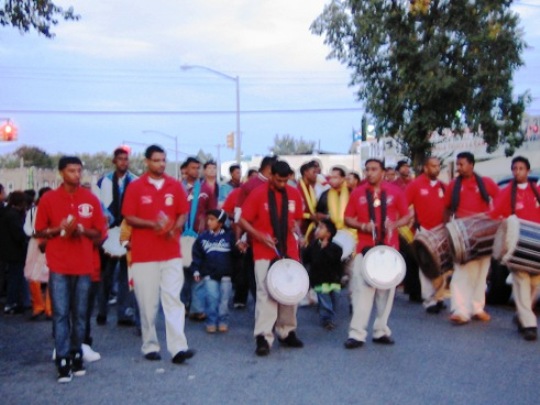
Tassa Group 'beating' their drums at a Diwali Parade on Liberty Avenue
But, the challenges facing American Hindus remain and are still daunting. These can be categorized in different groups, such as, the many challenges they faced in living and raising their children in a predominantly Christian society; due to the heavy Western influences, many parents exercise poor judgment in their parenting styles, many tolerate their children to practice the American lifestyle and forsake their own, so many petty in-fightings among themselves and the lack of understanding of Sanatan Dharma by other faiths.


The popular Sybils is one of the first restaurants to open up on Liberty Ave by immigrants from Guyana
Before migrating to the US, many of them lived in a predominantly Hindu society. In the US, they find themselves living and raising their children in a predominantly Christian society, where the way of life is vastly different from theirs. They now have to acclimatize themselves to their new surroundings and devise ways to maintain their unique Indian heritage and culture. In lieu of that, one of the biggest challenges Hindu parents face is transmitting the rich traditional and cultural values to their children. Many of them are finding it very hard to raise their children in the same disciplined manner they grew up in. Hence, there is a visible pattern of a continuous degeneration of the good "old-fashioned" Hindu values among young American Hindus. Just take a walk down the bustling Liberty Avenue in Richmond Hill at the end of any given school day. Groups of school children of East Indain descent can be found aimlessly walking home and they don't care if you hear their fowl language. Their freaky way of dressing would raise eyebrows, to put it mildly; their crude mannerism and poor conduct in public not only left much to be desired, but it speaks volume of their parents. Some would argue that parents do their best and in many instances, the children do their own thing with their peers at school and int eh streets. Well then, let's reassess that old saying: "Charity begins at home."  

Admittedly, the US is a very complex society, where "a melting pot of cultures" strives. But, according to Mr. Anantanand Rambachan, Chairman of the Department of Religion at St. Olaf College in Minnesota, “Hinduism is the least understood religion among American religious traditions.” An immigrant from Trinidad, Mr. Rambachan was a speaker at the conference on Hinduism in America, in Minnesota a few years back.

The famous Liberty Avenue in Richmond Hill, Queens

There are many reasons for the demoralization of the American Hindu society. Due to societal demands and trying economic times, in many Hindu homes, both mother and father are forced to work to make ends meet. A lot of their time and energy are directed towards juggling one task after another and not much quality time is spent with their children. There is not much official statistical data available to support this issue, but the facts speak for themselves. Just observe a Hindu family for a day to find out. In many Hindu homes, children are allowed to do things their way because of a lack of proper adult/parenting supervision. They watch a lot of TV with a strong influence of the Pop culture lifestyle; they play sometimes very violent video games; they listen to the latest Hip-Hop, string and heavy metal music and eat plenty of fast food, which are all easily accessible to them. This is the Westernized world they are growing up in and are sadly, embracing and can relate to.

Richmond Hill, Queens, New York, has a large population of Hindus who migrated from the West Indies and other parts of the world. Indeed, they have made great economic strides over the years. Many open and manage their own successful businesses in the community, which are lined on Liberty Avenue. Unfortunately, the famous avenue is home also to many night clubs, bars and lounges. On any given Saturday night, most of the popular hangout spots for the youngsters in the Richmond Hill area, is packed to capacity with young men and women: drinking, smoking, dancing and partying. Many of them are Hindus. Guess what? On the Sunday mornings, the turnouts at the mandirs are just the handful of the faithfuls – call them the frequent mandir-goers. The others are sleeping their hang-overs from the night before. This is just one scenario.

Acharya Krishna Moorty, the spiritual head at the Chinmaya Mission in New York, believes that one of the issues that Hindus face in the US is not knowing, “how to balance the standard of living with the standard of life. Acharyaji explains that the “standard of living is a measure of our lifestyle” which include, “education and skills, comforts, conveniences, financial security, objective pleasures and sensual indulgences, aimed towards happiness in life.”

On the other hand, he adds that the standard of life is a “measure of our faith, belief, values, attitudes, character, inner peace of mind, happiness, satisfaction and completeness, aimed towards happiness of life.” He points out that both are necessary, however, Hindus have to learn to prioritize their lives.

Young American Hindus also have issues to contend with. One of their main arguments is that Sanatan Dharma is confusing and too complicated because of the many Gods and Goddesses to be worshipped. Further, they pointed out that the rituals are many, lengthy and time-consuming. Then, there is the language barrier. Many of them, particularly those from the Diaspora, understand and speak only English. Therefore, they cannot grasp the meanings of the prayers, mantras or bhajans since these are written in either Sanskrit or Hindi. For these reasons, some young American Hindus feel reluctant to to practice their religion, others feel ill-informed about their religion and there are many who do not even identify themselves as Hindus.

Many of them have adapted the American lifestyle to blend in the American society because it is easier to do. Another major setback for American Hindus is that many of the Hindu festivals, such as Deepavali and Phagwah, are not recognized in their schools and well, mainstream America, for that matter. Celebrations for these festivals have to be performed in the evenings or on weekends, when it is more convenient for the families and mandirs to conduct such pujas. These are critical issues that have caused a major breakdown in the rich Hindu family tradition and also, one of the many reasons for youngsters to go astray. As a result, many young American Hindus are loosing their identity in the process.

Acharyaji asks the hard questions: “Identity, who are we?” Then, he throws in the million dollar question, “How can we really blend with the American society and still retain our identity?”

That has been a major roadblock for many American Hindu families. However, for every problem there is a solution. Acharyaji believes that “the solution depends on the assimilation the good values of both cultures and asserting our own heritage against aggressive cultures,” adding that “at the same time tolerating certain inadequacies and human errors in interacting with other faiths and culture.”

In most isntances, there is a solution to every problem, American Hindus have to seek them out. More than ever before, there is a need to have a unilateral system in place whereby all mandirs in the US are affiliated with one umbrella organization that would monitor the works of all mandirs across the country. This is a huge challenge by itself, but the dividends to be gained would be worthwhile. This parent body would have a long list of responsibilities to oversee, one main one being, to act as a mediator and a peace negotiator for the countless mandirs that are currently fighting their “Mahabharata wars” via a court system that does not understand their cultural values. The idea for an umbrella body would also bring a sense of uniformity among all the Hindu religious institutions and would admittedly, cause less conflict when calculating the correct dates for Hindu festivals for the calendar. Wouldn’t it be great if all mandirs in the US were to celebrate Deepavali or Shiva Ratri on the same day?

Next, the parent body needs to come up a set of basic rules for individuals interested in becoming pandits. This is a very contentious situation among the Hindus in the US and further afield and have to be addressed now or in the near future. Pandits must be properly educated, must be literate in speaking, writing and understanding Hindi and Sanskrit, must know how to perform major pujas and parbs, must be versed in Hindu scriptural texts, not only the Puranas, but also the Upanishads, which is the end part of the Vedas. The Upanishads contains the highest spiritual truths, which is criteria for liberation from mundane exitence. Pandtis must be groomed and nurtured from a very young age and must mostly certainly, conduct themselves in a morally upright manner. It is not a bad idea to give them a written test before they can practice ‘panditai’ work in the community. There are too many unqualified people calling themselves pandits who are misleading the Hindu population. This needs to be stopped.

Another pivotal issue that has to be addressed, now or later, is the one on the construction of Hindu schools in the community. It is imperative that the Hindu community pools its efforts, resources, money, time and energy together to work towards establishing Hindu schools and Hindu Universities in the US, in order to educate and nurture the growing young Hindu population. There is a demand for such institutions and the benefits therein are inumerable. Learning the Hindu concepts and ideas from a young age at a reputable Hindu school would encourage American Hindus to practice their religious beliefs with a sense of pride and joy. The only way they would be able to do that is if all or most of their misconceptions of Sanatan Dharma are removed and they understood this dynamic religion that is theirs. As the Mahatma once said, “A nation's culture resides in the hearts and in the souls of its people.” (Bina Mahabir)

Another view of Liberty Avenue


Friday, June 8, 2012

HATHA YOGA - AN INTERNATIONAL PHENOMENON!

Yoga has become an international phenomenon - overnight it seems. Whichever corner of the globe you may be residing at, you must have heard of yoga. Often time, the word Yoga is being used too loosely and at other times, some people don't even understand the deeper, true meaning of yoga. This article is written in "layman terms" with the intention of shedding some light to the lesser informed folks out there on the subject in the community.

So, what is yoga?

Yoga has many dimensions and basically, when many people are talking about it, they're referring to Hatha Yoga, which are the many, many body postures referred to as Asanas. Asanas in itself has been categorized into different groups with specific results for different peoples' needs.

Admittedly, yoga is not an easy subject to write on, with so much information already out there, but it needs to be written in simple language for all to grasp.

In an article posted on the website, www.abc-of-yoga.com, hatha yoga was by Yogi Swatmarama in ancient India.

(Will continue on this later)